
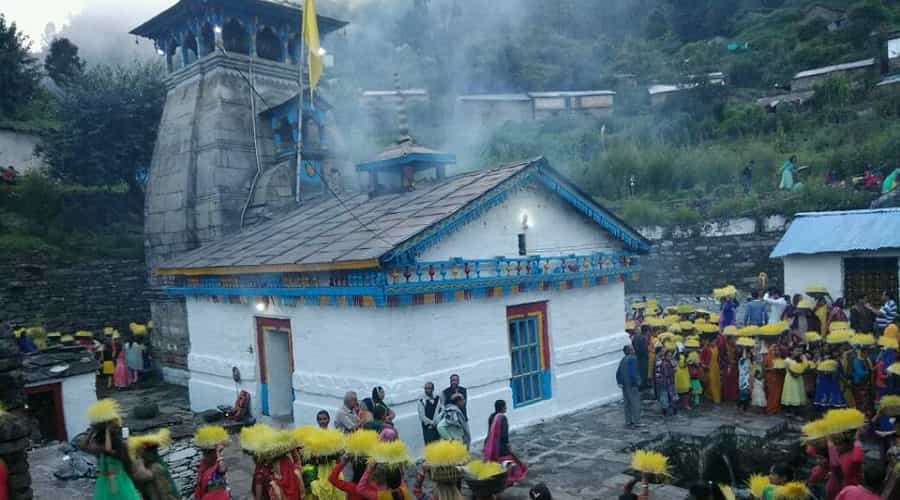
Triyuginarayan Temple – The Holy Wedding Destination of Lord Shiva and Goddess Parvati
Triyuginarayan sits in Rudraprayag district at 1,980 metres, a short trek off the main Kedarnath route. According to Hindu tradition, this is where Lord Shiva and Goddess Parvati were married, and the fire in front of the temple — the Akhand Dhuni — is traditionally believed to be connected to that wedding. Pilgrims have offered wood into it for generations. That’s the whole draw of the place: a small stone temple with a fire that’s older than anyone can date, and a legend most Hindus grow up hearing in some form.
This guide covers what you actually need before you go — timings, the real distances (several published online are wrong), wedding logistics, and what changed in 2026 for marriage registration in Uttarakhand.
Quick answer: Published temple timings are 7:00 AM–2:00 PM and 4:00 PM–8:00 PM, with no entry fee. The temple sits 14 km from Sonprayag by the official BKTC figure, the last 5 km of which is a forest trek. It doesn’t follow Kedarnath’s seasonal opening/closing calendar, but the approach road does get disrupted in heavy monsoon — it happened again in July 2026.
Key Facts
| Detail | Information |
|---|---|
| Location | Triyuginarayan village, Rudraprayag district, Uttarakhand |
| Altitude | 1,980 metres (6,496 ft) — confirmed by BKTC and Incredible India |
| Dedicated to | Lord Vishnu (Shiva, Parvati and Brahma also worshipped here) |
| Also known as | Akhand Dhuni Temple, Triyugi Narayan Mandir |
| From Sonprayag | 14 km by road, of which the final 5 km is a walking trail (BKTC) |
| From Kedarnath | 31 km (BKTC) |
| Nearest railhead | Rishikesh, 212 km to the Sonprayag approach (BKTC) |
| Nearest airport | Jolly Grant, Dehradun, 226 km to Sonprayag (BKTC) |
| Daily timings | 7:00 AM–2:00 PM and 4:00 PM–8:00 PM |
| Seasonal closure | None fixed, unlike Kedarnath/Badrinath — but road access can shut down in monsoon or heavy snow |
| Entry fee | None |
| Weddings | Permitted with advance booking |
The Legend
According to the Skanda Purana and local tradition, this village was once the capital of Himavat, Parvati’s father. Parvati won Shiva’s devotion through penance, and — as the story goes — the wedding itself happened here, with Vishnu giving her away as her brother and Brahma officiating as priest. Devas and sages are said to have witnessed it. The Akhand Dhuni in front of the temple is traditionally held to be tied to that fire.
The name breaks down simply enough: Tri (three), Yugi (Yuga, or age), Narayan (a name for Vishnu) — pilgrims have offered wood into the Havan Kund across three Yugas, by tradition. A stone called the Brahma Shila stands in front of the temple, marking where the wedding rituals are believed to have taken place; couples marrying here perform their vows around it.
The Jamloki Brahmins of Kedarghati are the temple’s priests. In the current age, they’re the ones who keep the fire going.
The Four Kunds
A stream called Saraswati Ganga rises inside the temple courtyard and feeds four ponds nearby.
| Kund | Associated with | Traditional use |
|---|---|---|
| Rudra Kund | Shiva | Bathing |
| Vishnu Kund | Vishnu | Purification |
| Brahma Kund | Brahma | Drinking water |
| Saraswati Kund | Saraswati | Source pond for the other three |
Local belief holds that women hoping to conceive bathe here seeking blessings for fertility — that’s the tradition as it’s told, not a medical claim. Ash from the Havan Kund is treated the same way, as a blessing for marital harmony rather than anything measurable.
What’s Inside
The temple follows the North Indian Nagara style — stone, minimal ornamentation, built to survive at altitude. It resembles Kedarnath and Badrinath closely enough that most visitors mention it unprompted. Inside sits a two-foot silver idol of Vishnu with Lakshmi; the complex also has shrines to Badrinarayan, Sita-Ramachandra, Saraswati, and Kubera. The Havan Kund, the Brahma Shila, and the Saraswati Ganga source are all in the open courtyard outside. The current structure is traditionally attributed to Adi Shankaracharya, the 8th-century philosopher credited with reviving several Himalayan shrines — this is tradition, not an archaeologically dated fact.
Timings
| Session | Hours |
|---|---|
| Morning darshan | 7:00 AM – 2:00 PM |
| Midday break | 2:00 PM – 4:00 PM |
| Evening darshan | 4:00 PM – 8:00 PM |
These are the published hours, matching what Incredible India lists officially. They can shift around festivals or special pujas, so don’t treat them as unbreakable — confirm locally if your trip lands near a major date. The one thing worth planning around firmly is the midday gap: arriving at 2:30 expecting entry is the most common way people waste half a day here.
Is It Open in Winter?
Triyuginarayan doesn’t have a BKTC-style kapat ceremony that opens and closes the temple on fixed dates each year, the way Kedarnath and Badrinath do. That’s a real and useful distinction. But don’t read it as a guarantee you can reach the temple whenever you like. Heavy snow and monsoon rain both hit the Sonprayag approach road hard, and it isn’t theoretical — in July 2026, landslides closed the Sonprayag–Triyuginarayan road and stranded vehicles, with local reports describing debris burying a roadside dhaba near Gaurikund. The temple itself wasn’t shut by decree. The road just wasn’t passable for a stretch. Plan around road conditions, not around a season you assume is “open.”
How to Reach
The last stretch from Sonprayag runs either as a 5 km forest trek on the Ghuttu–Kedarnath bridle path, or as part of the 14 km road route where jeeps run more often in peak season.
| From | Distance | Source/Note |
|---|---|---|
| Sonprayag | 14 km (incl. 5 km trek) | BKTC official figure |
| Rishikesh (rail) | 212 km to Sonprayag | BKTC |
| Dehradun (rail) | 251 km to Sonprayag | BKTC |
| Jolly Grant Airport | 226 km to Sonprayag | BKTC |
| Triyuginarayan → Kedarnath | 31 km | BKTC |
| Gaurikund → Kedarnath | Around 16 km trek | Commonly cited; BKTC’s own pages give slightly different figures in different places, so treat this as approximate |
| Delhi → Sonprayag | Long hill-road drive, well over 440 km | Route-dependent; expect a full day plus, don’t plan around a fixed hour count |
By road: NH 107 from Delhi, Haridwar, or Rishikesh runs to Rudraprayag and on to Sonprayag, which is a regular stop on the Kedarnath route with taxis and shared jeeps.
By train: Rishikesh is the nearest major station.
By air: Jolly Grant, Dehradun, has short flights from Delhi; book your onward taxi ahead of peak season since demand outstrips supply in May–June.
Longer trekkers sometimes approach via a multi-day Mussoorie–Tehri–Ghuttu route that eventually reaches Kedarnath through Triyuginarayan. It’s a serious undertaking, not a casual add-on.
Best Time to Visit
| Season | Months | Conditions |
|---|---|---|
| Spring/summer | April–June | Generally the most reliable roads and weather; also the busiest |
| Monsoon | July–September | Landslide risk on the Sonprayag approach — not a hypothetical, as 2026 showed |
| Autumn | September–November | Clearer skies, thinner crowds than summer |
| Winter | December–March | Cold, snow likely; road access is the real constraint, not the temple gates |
April–June and September–November give you the best odds of a smooth road. Winter visits happen — people do marry here in the cold — but only with flexible dates and a habit of checking road status the morning you leave.
Festivals
| Festival | When | What it marks |
|---|---|---|
| Gauri Shankar Vivah Puja | Around Sawan (Jul–Aug) and Karwa Chauth | Re-enactment of the Shiva-Parvati wedding |
| Kedar Festival | Shravan (Jul/Aug) | Draws heavy footfall from Kedarnath-bound pilgrims |
| Karwa Chauth | October (date varies) | Married couples and those seeking marital blessings visit in numbers |
| Navratri | April and October | Book accommodation well ahead |
Getting Married at Triyuginarayan
Couples marry here around the Akhand Dhuni, taking their Saat Phere with the Brahma Shila as the ceremonial centre. TV actress Kavita Kaushik married here in January 2017, in the middle of a cold snap — that’s the one celebrity wedding with solid, independently confirmed reporting behind it.
The ceremony, broadly:
- Ritual bath at Rudra Kund
- Vedic rites performed by a resident priest
- Saat Phere around the Akhanda Jyoti
- Rituals at the Brahma Shila
- Sacred ash given as prasad
- Closing prayers at the main Vishnu shrine
On cost: figures you’ll see quoted online — temple donation, priest fees, samagri — vary enough between sources that I’m not going to hand you a fixed number and pretend it’s reliable. Confirm current rates directly with the temple committee or your operator before booking. One number I can give you with confidence, because it’s on GMVN’s own tariff page: if you use GMVN’s property for a wedding function, open-area usage (lawns, catering space, halls) is billed separately from the room tariff, at ₹40,000 plus 18% GST per day. That catches people off guard if they assume the room rate covers the whole event.
Documents typically needed: age proof, proof of unmarried status if the temple committee asks for it, passport photos, and a written application.
On legal marriage: the temple ceremony is religious, not a legal registration. Since January 2025, Uttarakhand has run marriage registration under its Uniform Civil Code framework, and the process is now online for all couples regardless of religion, through the state’s UCC portal — a shift from the older system where you had to show up in person at a Sub-Registrar’s office with witnesses. Don’t rely on the temple to hand you legal paperwork. Register separately through the current UCC process, and check the state portal directly for whatever documents and timelines apply to your situation, since procedures have been updated more than once since the UCC came into force.
If you’d rather not chase this yourself, Chardham Tour (+91-7838908606) coordinates priest booking, permissions, stay, and transfers for Triyuginarayan weddings.
Where to Stay
At the village: GMVN’s Shiv Gaura Tourist Complex sits right by the temple — around 16 rooms across its guest-house blocks, based on GMVN’s own listings, not the higher figure some sites quote. Book through gmvnonline.com ahead of peak season. A few basic dharamshalas in the village run cheaper, more austere.
At Sonprayag, 5–12 km away: a much wider spread — budget guesthouses, mid-range hotels with hot water. Most take bookings by phone rather than through online travel platforms, so call ahead rather than assuming an app listing is current.
Nearby Attractions
| Place | Distance | Why go |
|---|---|---|
| Kedarnath Temple | 31 km (BKTC) | One of the twelve Jyotirlingas; opened 22 April 2026, expected to close around 11 November 2026 (tentative, BKTC to confirm closer to the date) |
| Gaurikund | Near Sonprayag, on the Kedarnath route | Associated in tradition with Parvati’s penance; base point for the Kedarnath trek |
| Sonprayag | 14 km | Confluence of the Mandakini and Songanga |
| Guptkashi | On the same route | Where, by tradition, Shiva proposed to Parvati |
| Tungnath | Further along the Chopta route | The highest Shiva temple in this range |
If you’re combining this with Kedarnath, Char Dham Yatra registration at registrationandtouristcare.uk.gov.in is mandatory for the Kedarnath leg — not because you’re visiting Triyuginarayan itself, but because you’ll pass through the Sonprayag checkpoint that requires it.
What to Pack
- Warm layers, even in summer — 1,980 m stays cool through the morning
- Sturdy shoes for the 5 km trek stretch
- Rain gear if you’re travelling July through September
- Cash — there’s no ATM in the village itself
- Basic first-aid and any personal medication
- Modest clothing suited to an active place of worship
Common Mistakes
- Assuming a fixed “reopening date.” There isn’t one — but assuming the road is always passable is its own mistake. Check current conditions, especially in monsoon.
- Arriving during the 2–4 PM break.
- Skipping the kunds and Brahma Shila outside the main shrine.
- Travelling in July–August without a backup plan. The 2026 road closure wasn’t an isolated event.
- Booking a wedding without enough lead time — coordinate at least a few weeks out.
- Forgetting cash.
- Skipping Char Dham registration if you’re continuing on to Kedarnath.
Why Book With Chardham Tour
Triyuginarayan is manageable to visit independently. Where a local operator earns its fee is in wedding coordination — priest booking, temple permissions, samagri, and accommodation — and in combined Kedarnath + Triyuginarayan itineraries where registration and timing actually matter. That’s a narrower, more honest pitch than claiming to solve every uncertainty of mountain travel, and it’s the part genuinely worth paying someone else to handle.
Contact: +91-7838908606 | www.chardhamtour.in | Wedding enquiries: www.chardhamtour.in/wedding-at-triyuginarayan-temple
FAQs
Does Triyuginarayan Temple close for winter like Kedarnath?
No fixed kapat schedule exists here, unlike Kedarnath and Badrinath. But winter snow and monsoon rain both affect the approach road — in July 2026, landslides shut the Sonprayag–Triyuginarayan stretch for days. Check road conditions before you travel, regardless of season.
What are the temple’s daily timings?
7:00 AM–2:00 PM and 4:00 PM–8:00 PM, per the published schedule. These can shift around festivals — confirm locally if your visit falls near one.
Is there an entry fee?
No. Donations are voluntary.
How far is Triyuginarayan from Kedarnath?
31 km, per BKTC’s official figure — several travel sites still quote 25 km, which doesn’t match the primary source.
What’s the actual distance from Sonprayag?
14 km by BKTC’s figure, with the final 5 km covered on foot through forest.
Can we get married at Triyuginarayan?
Yes, with advance booking. A resident priest conducts the Vedic ceremony, including Saat Phere around the Akhand Dhuni. Costs vary enough by source that we won’t quote a fixed figure — confirm directly with the temple or your operator. Note that this is a religious ceremony, not a legal registration; Uttarakhand’s UCC framework, in place since January 2025, handles that separately and online.
What’s the significance of the four kunds?
Rudra Kund (bathing), Vishnu Kund (purification), Brahma Kund (drinking water), and Saraswati Kund, which by tradition feeds the other three.
Where can we stay near the temple?
GMVN’s Shiv Gaura Tourist Complex, on-site, has around 16 rooms — book via gmvnonline.com. Sonprayag, 5–12 km away, has more options across a wider price range.
Who maintains the temple’s fire?
The Jamloki Brahmins, the temple’s priests, tend the Havan Kund and conduct daily rituals.
Do I need Char Dham registration just to visit Triyuginarayan?
No — but if you’re continuing to Kedarnath, registration at registrationandtouristcare.uk.gov.in is mandatory before the Sonprayag checkpoint.
What’s the best time to visit?
April–June and September–November, when the approach road is generally most reliable. Monsoon carries real landslide risk; winter brings snow and cold.
Is it manageable for families and older travellers?
The road route avoids the trek if mobility is a concern — take that option rather than the 5 km forest trail if you’re travelling with someone who has limited mobility. Confirm pony or doli availability locally rather than assuming it’ll be there.
Final Word
Triyuginarayan doesn’t need much dressing up — a stone temple, a fire people have tended for generations, four ponds, and a story most visitors already know some version of. The genuinely useful thing to understand before you go isn’t the mythology, though. It’s that this isn’t Kedarnath: there’s no fixed season to wait for, but the road can still shut on you with little warning, as it did in July 2026. Check conditions close to your travel date, book your priest or stay with real lead time if you’re marrying here, and confirm the legal paperwork separately — the temple ceremony and the government registration are two different processes now, under Uttarakhand’s UCC system.
To plan a visit or book a Triyuginarayan wedding package, contact Chardham Tour at +91-7838908606 or visit www.chardhamtour.in
2 thoughts on “Triyuginarayan Temple – The Holy Wedding Destination of Lord Shiva and Goddess Parvati”

Related Posts
Narad Kund, Badrinath
Neelkanth Peak, Badrinath
I want to get married in triyoginarayn
Shiv Shakti ko pata k meri shadi kisse hogi but i know triyuginarayan mandir me hi hogi , Mahadev Har