
Walk into any Garhwali or Kumaoni village during a wedding or a full-moon night, and you will hear the music before you see it. The deep beat of a dhol answers the sharp roll of a damau, and someone is already singing. Folk music of Uttarakhand is not a stage performance — it is how people mark birth, marriage, seasons, and grief. The songs change from ridge to ridge, yet each one carries the same Himalayan pulse.
This guide covers the major folk songs, dances, instruments, singers, and festivals that keep this centuries-old tradition alive — and how to experience it for real on a trip to Uttarakhand.
Quick Answer: Uttarakhand’s folk music is broadly divided into Garhwali and Kumaoni traditions, built around songs like Jagar, Mangal Geet, Basanti, Bajuband, Chhopati, and Khuded, and dances such as Chholiya, Langvir Nritya, and Barada Nati. These are performed with instruments like the dhol, damau, hurka, ransingha, and bhankora, and come alive most vividly during festivals such as Phool Dei, Harela, Kumaoni Holi, and the Ramman.
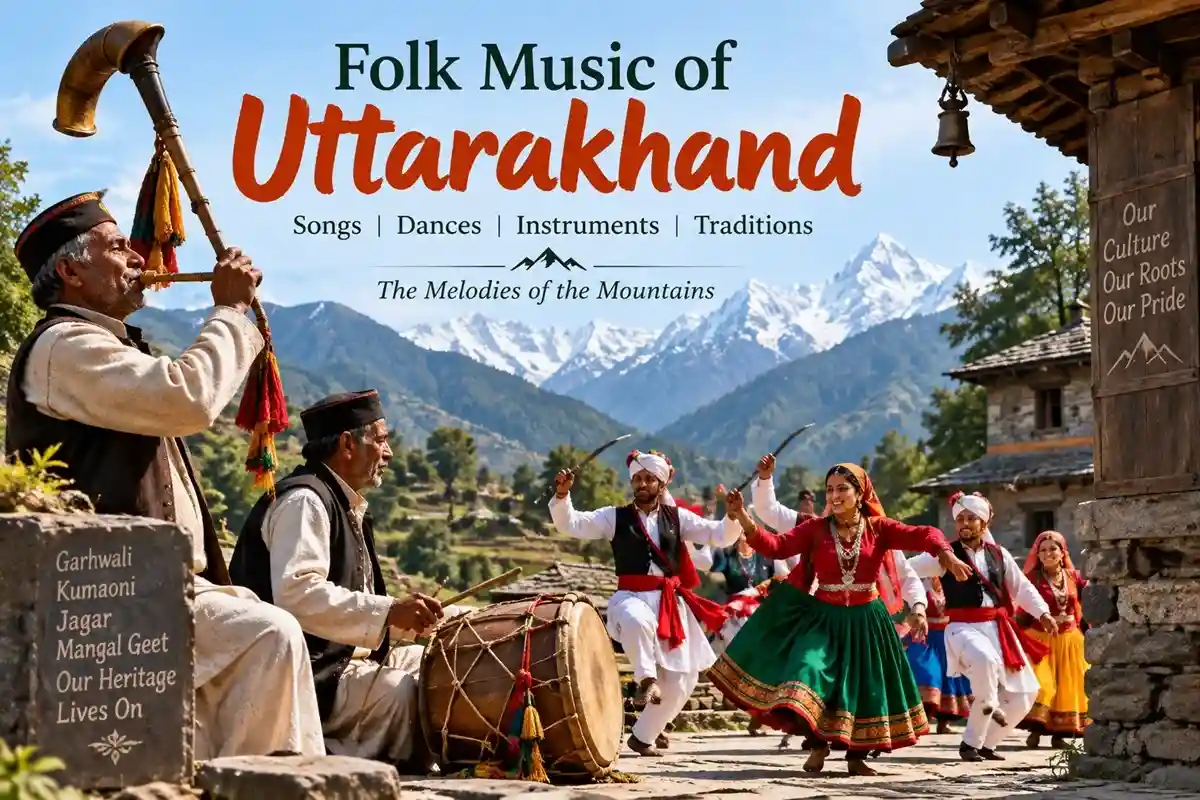
Garhwali vs Kumaoni Folk Music: What’s the Difference?
Uttarakhand has two main cultural belts — Garhwal and Kumaon — and each has its own musical personality. Garhwali music tends to be louder and faster, built for dhol-damau processions and martial dances. Kumaoni music leans softer, built around the hurka drum and slow, story-driven singing.
| Aspect | Garhwal | Kumaon |
|---|---|---|
| Typical tone | Energetic, rhythm-heavy | Melodic, gentler pace |
| Lead instrument | Dhol-Damau | Hurka |
| Signature song form | Mangal Geet, Khuded | Jhoda, Chhapeli, Baithaki Holi |
| Signature dance | Langvir Nritya, Pandav Nritya, Barada Nati (Jaunsar-Bawar) | Chholiya |
| Common theme | Weddings, valour, devotion | Nature, romance, migration |
Both traditions share the same core instruments and the same devotion to Jagar. These are broad tendencies, not strict rules — plenty of songs and instruments cross over between the two regions.
Traditional Musical Instruments Behind Uttarakhand’s Folk Music
No Uttarakhandi folk song stands alone — it is always carried by instruments still handmade in the hills today.
- Dhol and Damau – played together as a pair, these are among the best-known percussion instruments in the hills. Ceremonial and ritual occasions each carry their own rhythmic patterns, drawn from an oral tradition called Dhol Sagar.
- Hurka – a small hourglass-shaped drum central to Kumaoni music, especially the Hurkiya Baul singing style.
- Ransingha and Bhankora – long brass or copper wind instruments, originally used in war and now played in temple processions and ceremonial welcomes.
- Turri – a curved brass horn blown during religious ceremonies. In some local traditions it also carries a protective, ritual meaning.
- Daur-Thali – a drum-and-cymbal combination associated particularly with Jagar performances.
- Masakbhaja (also called Mashakbaja or Masakbeen) – a Himalayan bagpipe-style instrument, less common today but still seen in Garhwali processions.
Harmonium and tabla have entered the mix in recent decades, but dhol-damau remains the pair most Jagar and wedding singers still insist on.
Popular Folk Songs of Uttarakhand
Jagar
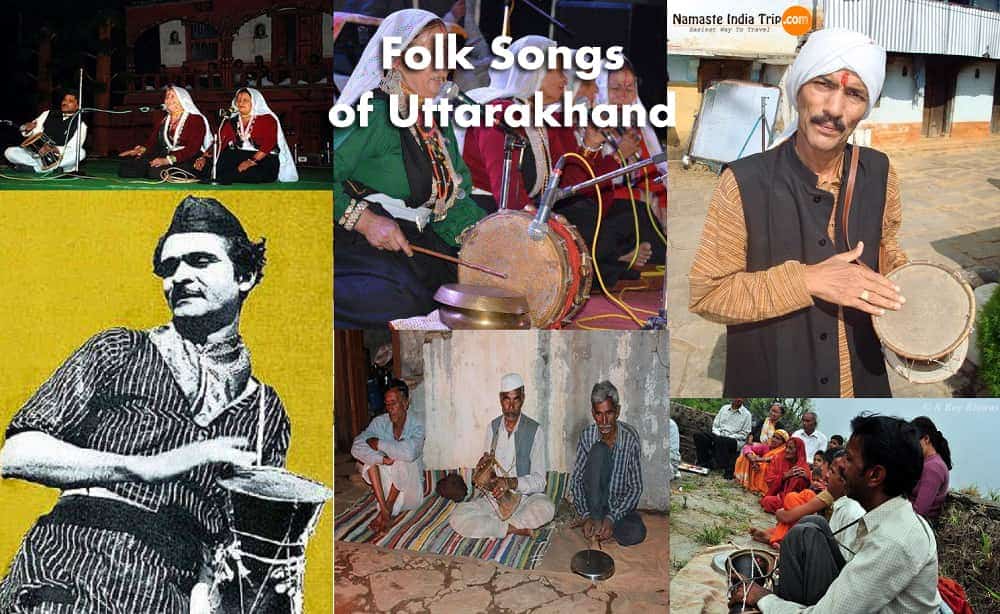
Jagar is a ritual tradition of folk singing in Uttarakhand, practised by both Garhwali and Kumaoni communities to invoke local deities and ancestral spirits. The word comes from the Sanskrit “jagran,” meaning to awaken — the singer, accompanied by the daur-thali, calls the deity into a medium during an all-night ritual, and it is also used to seek justice or resolution from the gods. This is traditionally a male practice, which is why Basanti Bisht’s rise as a Jagar singer is still spoken of with pride across the hills.
- Sung through the night, not as a short performance
- Invokes local deities and ancestral spirits
- Accompanied mainly by the daur and thali
- Used in some traditions to seek resolution or justice
- One of several ritual and musical elements woven into the Ramman festival
Mangal Geet and Gaali Mangal Geet
Mangal Geet are auspicious songs composed for weddings and sacred ceremonies, sung while the family priest chants Sanskrit shlokas alongside. Gaali Mangal Geet, a lighter variant, weaves in playful teasing between the bride and groom’s families — language considered harmless tradition here. These songs remain an important part of many Garhwali weddings.
- Sung during weddings and religious ceremonies
- Performed alongside Vedic shloka chanting
- Gaali variant includes affectionate teasing between families
- Central to Garhwali wedding rituals
- Adds humor and warmth to formal ceremonies
Basanti
Basanti songs welcome the shift from winter to spring, timed with the blooming of wildflowers across the high meadows. Unlike ritual songs, Basanti can be sung individually or in groups with no fixed occasion — people simply burst into song when the hillsides turn colourful.
- Celebrates the arrival of spring
- Often sung spontaneously, without a fixed ritual
- Reflects the blooming of high-altitude flowers
- Associated mainly with Garhwal, though the spirit of the season is shared more widely
- Usually cheerful and fast-paced
Bajuband
Bajuband is a traditional Uttarakhand folk song, and its description varies by source: some describe it as sung by village women during daily chores, expressing love, longing, and everyday emotion; others tie it more specifically to shepherd communities, sung as a love dialogue between a man and a woman. Both threads run through the form, and which one dominates seems to depend on the village and the singer.
- Themes of love, longing, and everyday emotion
- Described in some traditions as women’s daily-chore singing
- Described in others as a shepherd love dialogue
- Known for poetic, nature-heavy imagery
- Common in both festive and everyday settings
Chhopati
Chhopati is a lively call-and-response love song performed between a man and a woman, most associated with the Rawain-Jaunpur belt of Tehri Garhwal. Backed by dhol, dholki, turri, and mandan, it usually comes with an accompanying dance.
- Performed as a question-answer duet
- Popular in the Rawain-Jaunpur region of Tehri Garhwal
- Accompanied by dhol, dholki, and turri
- Falls under the “love song” category
- Usually paired with a lively dance performance
Khuded
Khuded songs, centred in the Garhwal region, voice the sorrow of a woman separated from her husband, who has left the hills for work in the plains. The lyrics blend three themes at once — the changing season, financial hardship, and personal separation — and this theme of migration still resonates strongly, since out-migration for work remains common in the hills today.
- Reflects the pain of separation caused by migration
- Common theme across Garhwali folk poetry
- Blends seasonal, economic, and emotional layers
- Sung mostly by women
- Slow, melancholic melody
Chhura
Chhura songs are advisory verses sung by shepherd communities, passed from older generations to younger shepherds heading out to graze sheep and goats. Both men and women take part, and elders usually preserve and pass on the exact wording.
- Passed down as practical, life-experience advice
- Traditionally sung by shepherd communities
- Performed by both men and women
- Elder-led preservation of exact lyrics
- Tied closely to pastoral, grazing life
Jhumailo
Jhumailo is a group song-and-dance form found across Uttarakhand’s folk traditions, including in Kumaoni practice, with dancers moving in a circular pattern while singing call-and-response. It is a clear example of how, in Uttarakhand, song and dance are rarely separated.
- Combines singing with circular group dance
- Found in both Garhwali and Kumaoni folk practice
- Common at festivals, fairs, and weddings
- Built on a call-and-response structure
- Reinforces community bonding during celebrations
Folk Dances of Uttarakhand
Folk songs in the hills rarely stand alone — most come paired with a dance form, and travellers who only read about the music miss half the experience.
- Chholiya – a sword-and-shield dance from Kumaon, traditionally performed during wedding processions and, in local belief, thought to ward off evil spirits. Accompanied by dhol, ransingha, and turri.
- Langvir Nritya – an acrobatic pole dance from the Tehri Garhwal region of Garhwal, performed by men only, where a dancer balances on his stomach atop a tall bamboo pole while performing stunts.
- Barada Nati – a graceful dance from the Jaunsar-Bawar region near Chakrata, performed by both men and women in colourful traditional dress.
- Chhapeli – a romantic duet dance performed by couples, often at fairs, symbolising the bond between lovers.
- Pandav Nritya – a dance-drama from Garhwal retelling episodes from the Mahabharata. Its length varies a good deal by village and local tradition, running anywhere from a few days to several weeks.
Folk Singers Who Carried This Music Forward
Uttarakhand’s folk tradition survives today largely because of a handful of artists who kept it going.
- Basanti Bisht – widely credited as the first professional woman to sing Jagar, awarded the Padma Shri in 2017 for her contribution to the arts.
- Narendra Singh Negi – a major performer of Garhwali and Kumaoni folk music, recognised with the Sangeet Natak Akademi Award in 2018.
- Gopal Babu Goswami – a Kumaoni folk-music figure whose songs remain foundational to the genre.
- Kabootri Devi – a well-known Kumaoni folk voice, associated with radio performances and traditional songs.
- Meena Rana – a contemporary female voice in Garhwali and Kumaoni folk and devotional music.
- Pritam Bhartwan – a Jagar and folk singer known for blending traditional forms with modern arrangements.
Festivals Where You Can Experience Uttarakhand’s Folk Music Live
Reading about these songs only gets you so far — the real experience happens at a festival, where music, dance, food, and ritual all arrive together.
Kumaoni Holi
Kumaoni Holi is unlike the colour-throwing Holi seen elsewhere in India — it is primarily a musical festival built around classical-style singing sessions called Baithaki Holi and Khari Holi. Villagers gather over several weeks before the main day, singing raga-based compositions to the rhythm of dhol and hurka, often late into the night. Women hold their own version called Mahila Holi. If you’re in Almora, Nainital, or Bageshwar in the weeks before Holi, you’ll hear this music drifting out of homes well before the actual festival day.
- Built around structured singing sessions, not just colour play
- Baithaki Holi is sung sitting in a classical style
- Khari Holi is sung standing, often during processions
- Mahila Holi is a separate women-led celebration
- Best experienced in Kumaon towns like Almora and Bageshwar
Phool Dei
Phool Dei marks the arrival of spring on the first day of the Hindu month of Chaitra, and children — especially young girls — play the central role. They visit each house with plates of rice, flowers, and jaggery, placing flowers at the doorstep while singing traditional wishes for the family’s prosperity, and receive sweets or money in return. In some villages, the celebration stretches on for close to a month.
- Celebrated on the first day of Chaitra (March-April)
- Young girls decorate doorsteps with fresh flowers
- Accompanied by traditional wish-singing at each home
- Families offer jaggery, rice, or money in return
- Can extend for several weeks in some villages
Harela
Harela, meaning “greenery,” celebrates the start of the monsoon and is deeply tied to agriculture and environmental respect. Families sow seeds in small containers ten days before the festival, and the resulting sprouts are cut and placed on family members’ heads as a blessing for prosperity. Folk songs and the acrobatic Langvir Nritya dance mark the celebrations, especially in Kumaon.
- Celebrated in mid-July, ahead of the monsoon
- Seeds are sown ten days before and grown into sprouts
- Sprouts are placed on family members as a blessing
- Marked by Langvir Nritya and folk singing in Kumaon
- Treated as an ecological festival encouraging tree planting
Nanda Devi Raj Jat and Nanda Devi Mela
The Nanda Devi Raj Jat is the grand, once-in-twelve-years pilgrimage from Nauti to Homkund honouring Goddess Nanda Devi, accompanied by a four-horned ram called the Chausingha Khadu. Worth knowing before you plan a trip: the full Raj Jat originally expected in 2026 has been postponed to 2027 by the Raj Jat Committee, citing weather and infrastructure concerns at high altitude. A separate, shorter pilgrimage — the Nanda Devi Badi Jat, organised by the Kurud Temple Committee — is going ahead in September 2026, so the two shouldn’t be confused when you’re checking dates. Alongside these larger events, a smaller annual Nanda Devi Mela is held in towns like Almora and Nainital, filled with folk performances, music, and crafts — a reliable place to see Kumaoni folk dance and Jagar performed together most years.
- Full Raj Jat pilgrimage occurs roughly once every 12 years, from Nauti to Homkund
- Postponed from 2026 to 2027 by the Raj Jat Committee
- A separate Nanda Devi Badi Jat is taking place in September 2026
- Annual Nanda Devi Mela held in Almora and Nainital
- Features folk dances, music, and craft stalls
Ramman
Ramman is a UNESCO-recognised ritual festival held every year in late April in the twin villages of Saloor-Dungra in Chamoli district. Over several days, the community performs masked dances, sings the local version of the Ramayana, and conducts Jagar rituals dedicated to the village deity, Bhumiyal Devta. It was inscribed on UNESCO’s Representative List of Intangible Cultural Heritage in 2009 and is specific to this location — one of the clearest windows into how Uttarakhand’s music, ritual, and theatre come together.
- Held annually in late April at Saloor-Dungra, Chamoli
- Recognised by UNESCO as Intangible Cultural Heritage in 2009
- Combines masked dance, Jagar, and Ramayana recitation
- Performed by different castes, each with a fixed role
- Specific to Saloor-Dungra, though related traditions exist elsewhere in the Garhwal Himalayas
How to Experience This Culture on Your Uttarakhand Trip
If you’re travelling through Uttarakhand for the Char Dham Yatra or a hill tour, look for officially announced cultural festivals, village fairs, and local performances rather than assuming they’ll happen on schedule — dates shift with the lunar calendar and local decisions. Homestay hosts and local tourism offices are often the best source for what’s happening nearby during your stay. Jagar and other ritual performances should be approached with permission and respect, since they’re religious ceremonies first and a cultural experience second.
Common Mistakes Travellers Make
- Assuming Uttarakhand’s folk music is one uniform style, when Garhwal and Kumaon have distinct — if overlapping — traditions
- Treating Jagar as casual entertainment instead of the ritual it actually is
- Booking around a multi-year festival like the Nanda Devi Raj Jat without confirming the current year’s schedule
- Expecting recorded or filmi versions instead of the raw, live acoustic style
- Not asking locals or homestay hosts about nearby fairs, which are rarely advertised online
Pro Tips to Enjoy Authentic Folk Performances
- Time your trip around festivals like Phool Dei, Harela, or Kumaoni Holi for the fullest experience
- Prefer smaller villages and homestays over city hotels for genuine, unscripted performances
- Ask before recording a Jagar ritual — some ceremonies are considered too sacred to film
- Look out for Basanti Bisht, Narendra Singh Negi, or Pritam Bhartwan performances or recordings before your trip to build context
- Keep evenings free during your yatra itinerary instead of packing every hour with sightseeing
Why Explore Uttarakhand’s Culture With Chardham Tour
If you’d like your Char Dham or Uttarakhand itinerary to include real cultural experiences — village stays, local festivals, cultural evenings — alongside temple darshan, talk to our travel team about building that into your package.
Frequently Asked Questions
Q1. What is the folk music of Uttarakhand called?
It has no single name — it includes forms like Jagar, Mangal Geet, Basanti, Bajuband, Chhopati, and Khuded, sung in both Garhwali and Kumaoni styles.
Q2. What is Jagar in Uttarakhand folk music?
Jagar is a ritual style of singing used to invoke local deities and ancestral spirits, traditionally performed through the night by trained singers called Jagariyas.
Q3. Who is the famous Jagar singer of Uttarakhand?
Basanti Bisht is the most well-known, widely credited as the first professional woman to sing Jagar; she was awarded the Padma Shri in 2017.
Q4. What instruments are used in Uttarakhand folk music?
The dhol, damau, hurka, ransingha, bhankora, turri, and daur-thali are among the most common traditional instruments.
Q5. What is the difference between Garhwali and Kumaoni folk music?
Garhwali music tends to be faster and dhol-driven, while Kumaoni music leans slower and melodic, centred around the hurka drum — though many forms and instruments overlap between the two.
Q6. What are the popular folk dances of Uttarakhand?
Chholiya, Langvir Nritya, Barada Nati, Chhapeli, and Pandav Nritya are among the best-known folk dances.
Q7. Which festivals are good for experiencing Uttarakhand folk music?
Kumaoni Holi, Phool Dei, Harela, and the Ramman festival all offer strong folk music experiences, each in a different form — from classical-style singing sessions to ritual theatre.
Q8. Is Uttarakhand folk music only religious?
No, it also covers love, farm life, migration, seasons, and everyday emotions alongside devotional themes.
Q9. Can tourists watch a Jagar performance?
Tourists can sometimes watch respectfully in villages during festival season, but Jagar is a religious ritual first — always ask permission before watching or recording.
Q10. What is Basanti in Uttarakhand folk music?
Basanti is a folk song category, associated mainly with Garhwal, that welcomes spring and the blooming of hillside flowers.
Q11. Where is the Ramman festival held?
Ramman is held every year in late April at the twin villages of Saloor-Dungra in Chamoli district, and is recognised by UNESCO.
Q12. Is the Nanda Devi Raj Jat happening in 2026?
The full 12-year Nanda Devi Raj Jat from Nauti to Homkund has been postponed to 2027. A separate, shorter Nanda Devi Badi Jat is taking place in September 2026 — check current dates before planning a trip around either one.
Conclusion
Uttarakhand’s folk music is not a museum piece — it is still sung at real weddings, still called out during real rituals, and still danced at village fairs every season. From the ritual pull of a Jagar to the cheerful burst of a Basanti song, this music tells you more about the hills than any monument can. If your Char Dham Yatra has room for one evening in a village or one local fair, take it — that is where this tradition is still alive, unscripted, and waiting to be heard.
Planning your Uttarakhand trip? Explore our Char Dham Yatra packages or read more about the Festivals of Uttarakhand to build a culturally rich itinerary.
Sources & References
This article draws on UNESCO’s Intangible Cultural Heritage listing for Ramman, the Government of India’s Padma Awards records, the Sangeet Natak Akademi’s citation for Narendra Singh Negi, and Uttarakhand government and KMVN cultural resources on regional folk songs, dances, and instruments. Festival scheduling for the Nanda Devi Raj Jat and Badi Jat reflects committee announcements current as of September 2026 and should be reconfirmed closer to your travel dates.
2 thoughts on “Folk Songs and Music of Uttarakhand”
Leave a Reply

Related Posts
Sayanachatti to Yamunotri Guide

Dharchula: Gateway to Adi Kailash, Om Parvat & Kailash Mansarovar
Hey, It was really helpful for me.
Please elaborate some raagas tallas in this music